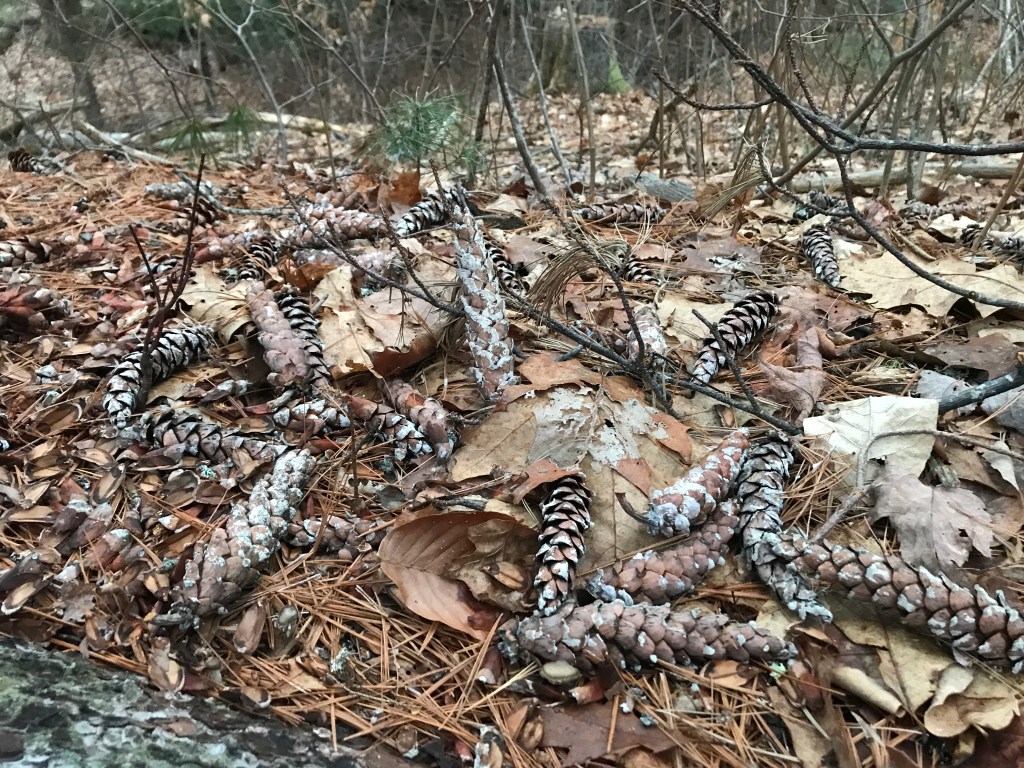
Some years, pine trees release an abundance of cones; So why does this happen? Many studies have been done on this question, and are increasing in frequency: from about 400 in the 1980’s to almost 4,000 in the 2010’s! Why the increase!? Money’s one reason: pine nuts of certain species are tasty, so the agricultural importance is evident—as are the effects of global warming on this agriculture; more on this later.
Pine cones are a type of “mast”, the botanical name for the nuts, seeds, buds, or fruits of trees and shrubs that are eaten by wildlife. There are two main types of mast: hard mast—nuts and seeds; and soft mass—berries and fruits. All mast is an important year-round food source for wildlife and humans, and all nut and seed-bearing trees like oaks, white spruce, sugar maples, beech and hickory trees produce mast. The seeds within a pine cone are hard mast. And pine cones take two years to mature. So the cones currently under our pine trees began their growth in late summer of 2021, and matured and fell this fall; The importance of this timing comes a bit later, too.
All trees have boom crops of seed some years and minimal crops other years. A “Mast Year”, or “Masting”, is when trees produce a bumper crop, covering the forest floor with nuts and seeds: An 11 year University of California study of 10 separate sites over 434 square miles found that masting occurred in virtually every one of approximately 100 million trees! The reason for masting is an ongoing field of study, but temperature, rainfall, and predation seem to be the leading theories—with the underlying fact that the biological imperative of all living things is to reproduce, and there are many factors that cause and/or allow various biologics to do this.
The predation theory describes mast years reacting to intense foraging: With so many pine cones produced, it’s impossible for all of their seeds to be gathered and eaten by forest critters. Thus, the remaining seeds are able take root thereby ensuring propagation. This “predator satiation” theory helps support some findings that some tree species’ seedings are mostly established during mast years.
Some scientists have suggested that the interval between mast years may also be necessary for trees to recover their energy and mineral reserves from the last high-output year and to accumulate enough energy for the next one: the “Recovery Theory”.
The “Stress Theory” subscribes to the thinking that trees stressed from, say, insufficient water tend to produce more seeds. Earlier we talked about timing being a factor in pine cone production. In 2021, we had an average spring rainfall, but 8 out of 12 months were drier than normal with widespread moderate drought: It 49th driest since 1895. 2021 is the year that the pine cones now on the forest floor began their lives, giving credence that the stress of dryness was the tree’s reaction to this year’s masting event.
Let’s return to the combined global warming/money factors. A long term study on those tasty pine nuts (seeds) indicated that there were fewer mast years with fewer pine cone produced during 2003-2012 than during 1969-1978. The causes for these findings led the study to consider that the estimated a 33% reduction in pine nut production—the money factor—could be due to increasing temperatures during both late summers and growing seasons during these decades ( i.e., Global Warming ), inhibiting seed cone production. These findings suggest that those who gather the edible pine cone seeds for woodland regeneration (USFS managers, etc.), culinary purposes (hobbyists), or survival (wildlife) face greater difficulties today than in the past, and they likely will endure even greater troubles in the Global Warming future.
And then, there’s this hormone called gibberellin, made by plants and the human chemical industry, that induces cone growth…but we’re already approaching 700 words!
Back to the question: “Why are there so many pine cones this year?” Well, scientists do not know. So: Pick a theory, or maybe just enjoy the mystery and marvel at how Nature cares for her trees!
 Mousam Way Land Trust